When you guide in Nantes, it's always frustrating not to be able to show all of the city's wonders in a two-hour walk. When you take the time to explore, you realise that the "Sleeping Beauty" hides a host of strange, discreet or downright unlikely places. Although they're too far from my usual routes for me to take you there, I'm determined to introduce you to them today!
This article is my list of off-the-beaten-track favourites. Places that tell the story of Nantes differently: through wastelands gone wild, Art Deco offices, forgotten machines and hidden artworks. Time to go and find them!
1. The Péage Sauvage, a motorway handed back to nature
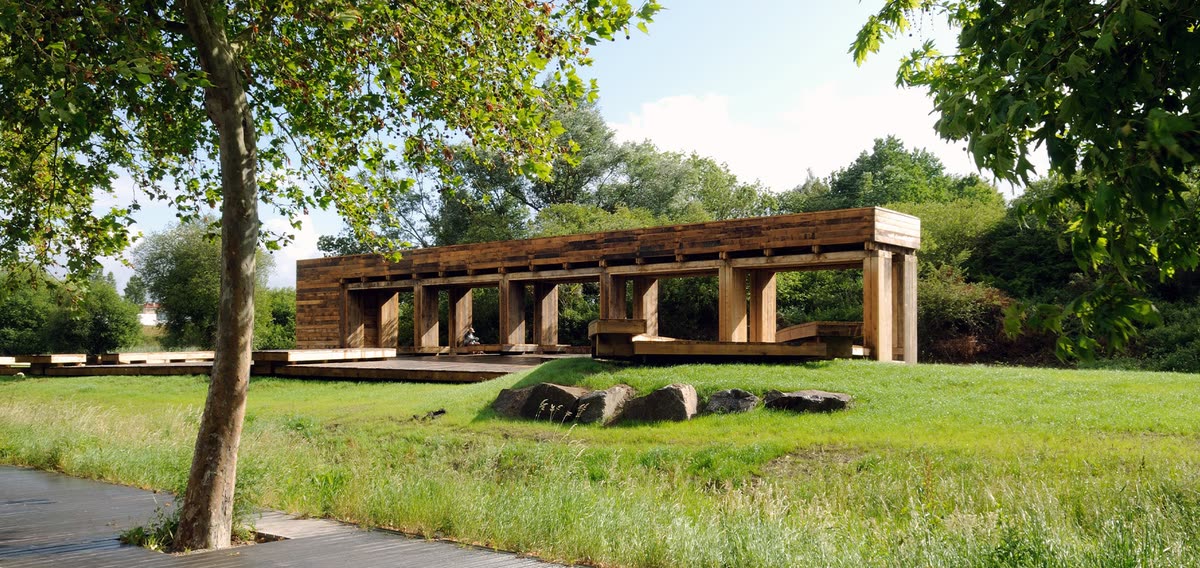
A stone's throw from the railway station, the Petite Amazonie ("Little Amazon") lives up to its name. This area, badly hit by bombing during the Second World War, was earmarked for an urban expressway in the 1970s: the earth dug out for the foundations of the Tour Bretagne was even dumped here as fill. The project was dropped, nature took over, and this marsh is now a Natura 2000 site with exceptional biodiversity.
In 2012, for the Estuaire biennial and the centenary of the LPO (France's bird protection league), the Dutch collective Observatorium installed the Péage Sauvage ("Wild Toll"): a large wooden sculpture shaped like a stretch of motorway with its toll booth, turned into an observation walkway.
What fascinates me is the irony of the place. A failed road project gave birth to one of the wildest spaces in the city, and the artwork turns a symbol of speed into an invitation to slow down. You can glimpse it from boulevard de Berlin, but you can only get close on the LPO's guided visits, as the park is not open to the public.
2. The Halle de la Madeleine, the phoenix of the Olivettes
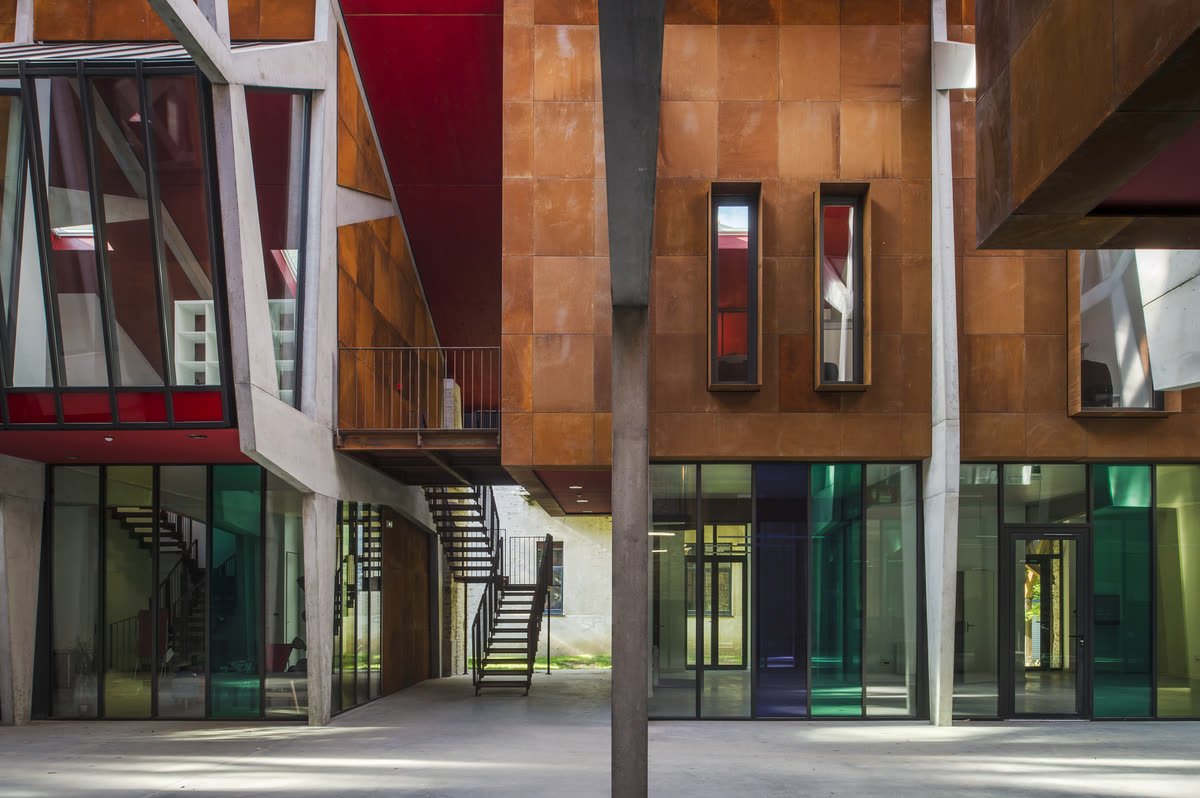
You have to look for it: the Halle de la Madeleine hides at the end of the impasse Juton, between the chaussée de la Madeleine and rue des Olivettes. Behind its wrought-iron gate lies a covered passage lined with palm trees. It began life around 1910 as a postal relay hall, in a district built by filling in a former island of the Loire. Relays were where riders traded in an exhausted horse for a fresh nag on long delivery journeys.
Converted into workspaces in 2010, it housed the Cantine numérique (a digital hub) until a violent fire destroyed its pine roof structure one November evening. Rather than demolish it, architects Pierrick Beillevaire and Solen Jaouen (In Situ) rebuilt it in 20 months: a frame of ultra-high-performance fibre concrete, light enough to rest on the old foundations, from which hang offices shaped like wooden "boxes".
I love this place because it sums up Nantes: a city that has recently decided to throw nothing away, that recycles its utilitarian buildings and reinvents them. Walking through the hall takes you in a few steps from an early 20th-century postal relay to bold contemporary architecture.
3. The CGA building, an Art Deco treasure under a dome
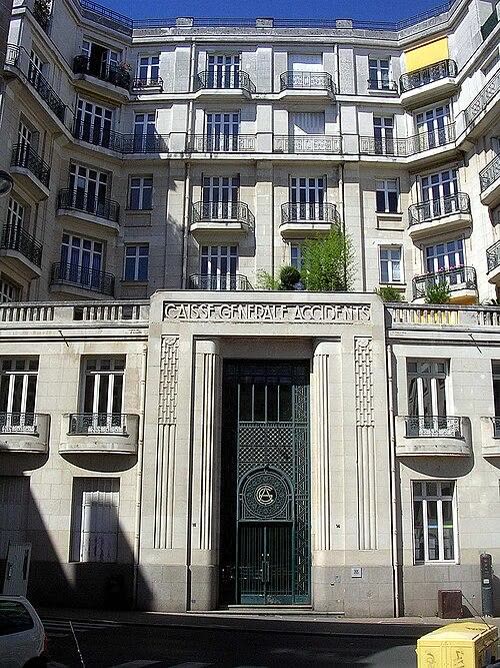
At 14-16 rue Racine, the CGA building almost goes unnoticed. Built between 1932 and 1935 by architects Henri Vié senior and junior as the headquarters of an insurance company for building contractors, it has a façade that is restrained in its decoration yet luxurious, reminiscent of grand seaside hotels. Only the lettering above the porch, the stepped-back upper floors with their terraces and the splendid, strikingly vertical door give away its era.
Inside, Art Deco bursts into life: an entrance hall covered in geometric mosaics, glass-block partitions, smooth doors with aluminium handles and above all a great circular skylight of concrete and white, yellow and orange glass blocks, crowning a hall ringed by a mezzanine with geometric ironwork. The building has been a listed historic monument since 2015.
This building is one of my favourites: it is spectacular, and one of the few examples of Art Deco still standing in Nantes.
4. The former PTT building, mosaics above the Loire
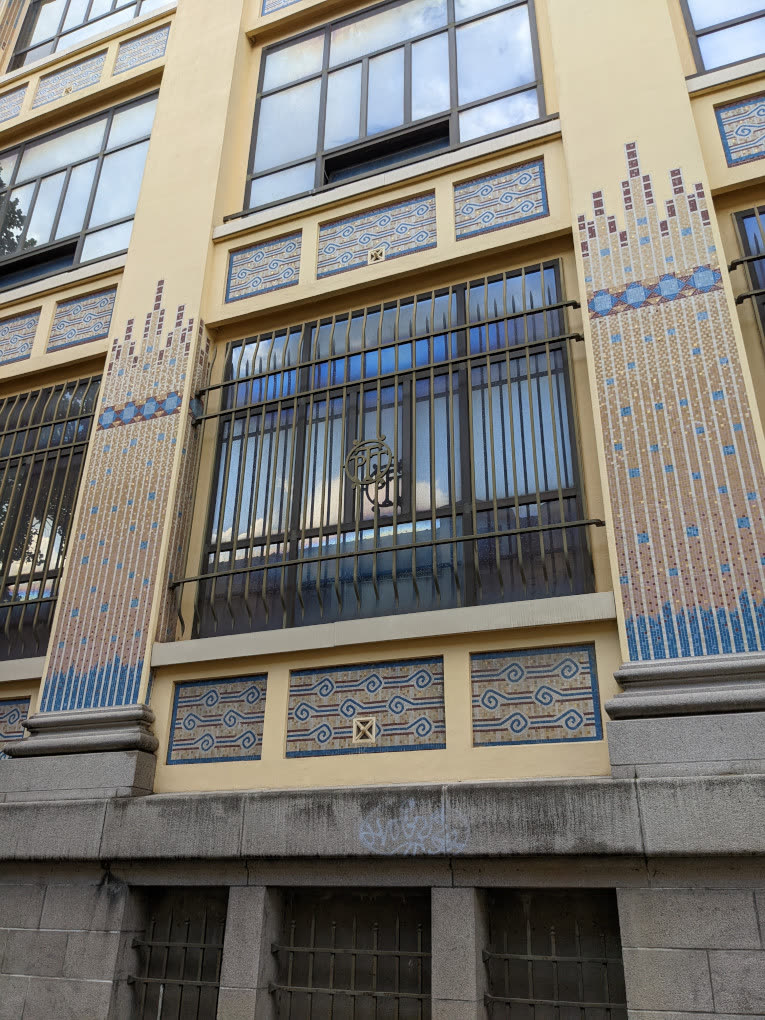
Staying with Art Deco: at the end of October 1927, after years of waiting, Nantes opened its first automatic telephone exchange, the "Cambronne" exchange. To house it, the PTT (the French post and telecoms administration) built a "two-faced" building between rue Maurice-Sibille and rue de l'Héronnière: on the Cambronne side, a 19th-century façade where only the window grilles bear the PTT initials; on the Loire side, a modern block of brick and concrete designed by Charles Giroud, the PTT's architect, with Henri Vié.
That south façade is a treat: pilasters striped with brown and gold bands, blue scrolls and matching brackets, all in mosaic on reinforced concrete. Planned with two storeys, the building gained an extra floor as early as 1929, sacrificing a terrace that offered a stunning view over the river.
You might not realise it, but its installation was a real revolution in telecommunications! Thanks to the dozens of kilometres of cable laid, people in Nantes could now be connected directly to the person they were calling, without going through a switchboard operator.
5. The Guinguette du Belvédère, an ocean liner on stilts
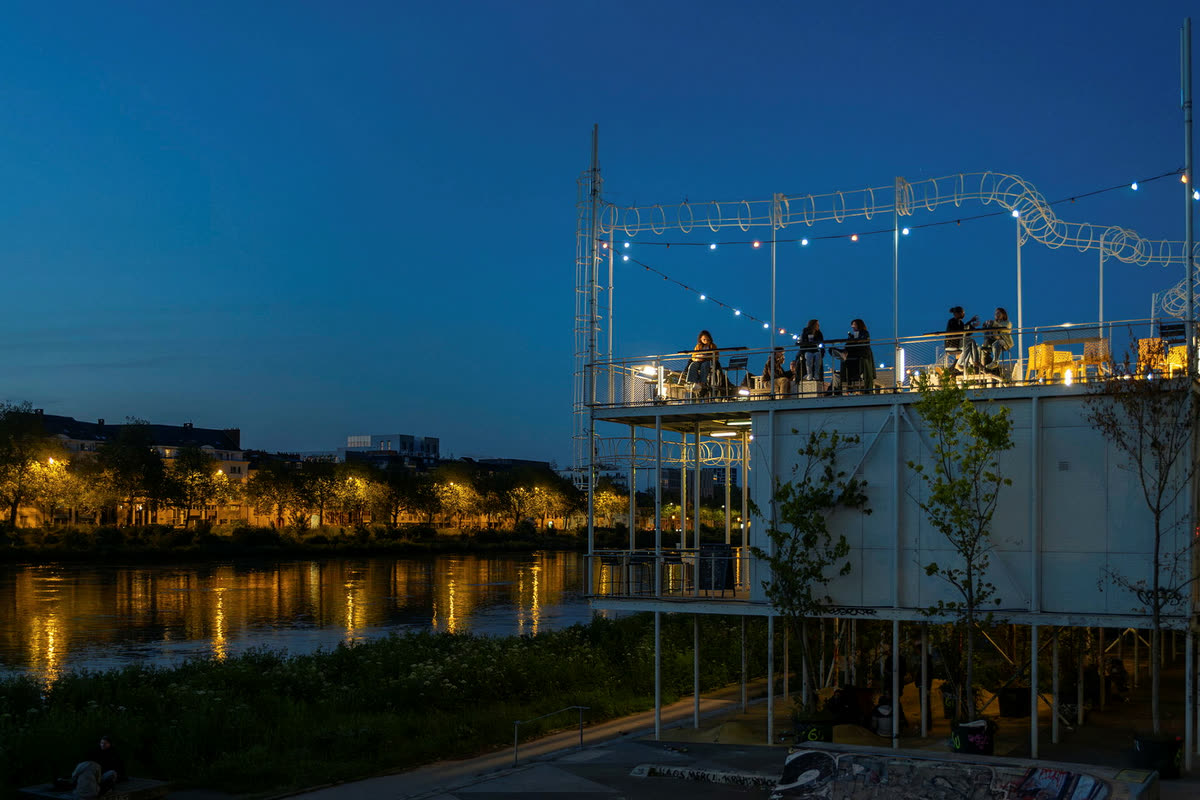
On the eastern side of the Île de Nantes, an odd structure gazes at the Loire. The Guinguette du Belvédère (a guinguette is a traditional riverside open-air bar) was born in 2019 from a wish voiced by Nantes residents during the "Nantes, la Loire et nous" public debate: to reconnect with the river and reclaim its banks.
Its architecture looks nothing like a traditional guinguette: a two-level metal structure on stilts. With its walkways and raised viewpoint, it looks like an ocean liner moored to the quay.
What I love here is the rare view of the Loire and its banks, far from the bustle of the city centre. Come between April and early October for a sunset drink, a concert or a show, with the feeling of having left the city without really leaving it.
6. Miroirs des temps, glass deer in the Miséricorde cemetery
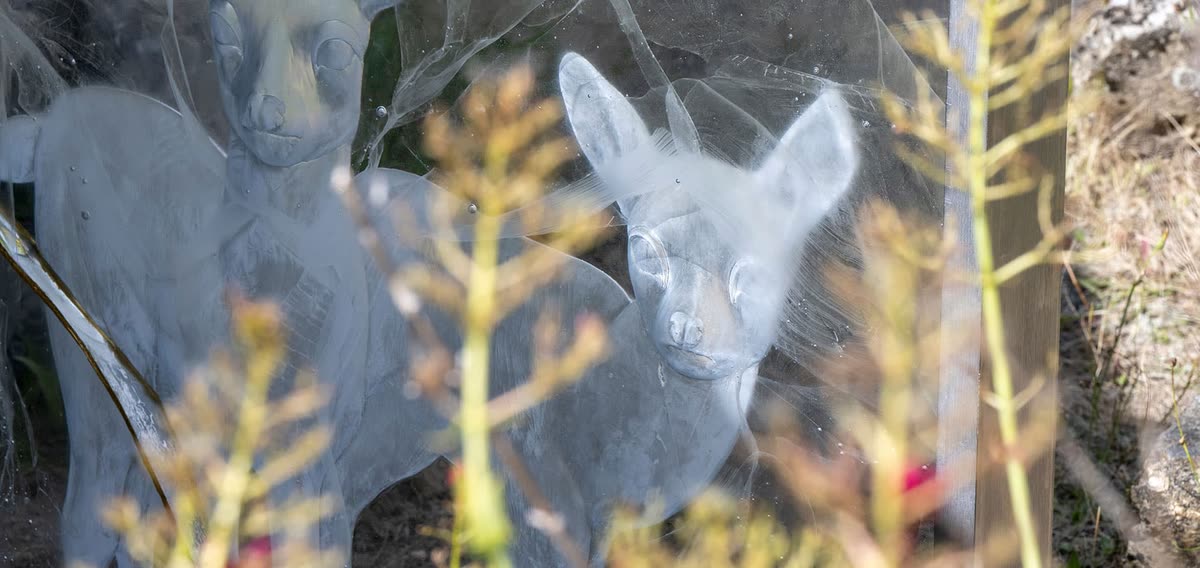
Opened in 1793, the Miséricorde cemetery is often called "Nantes' Père-Lachaise": its 9 hectares hold the city's great families and figures such as General Cambronne. Since pesticides were abandoned, its oldest section has been reclaimed by vegetation, and that is exactly where artist Pascal Convert installed his work Miroirs des temps ("Mirrors of Time") in 2022.
Working with master glassmaker Olivier Juteau, he slipped slabs of cloudy, gold-streaked glass among the graves, in which a stag, a hind, a roe deer and two fawns appear in bas-relief. Depending on the angle, the animals seem to emerge and then fade away, and their gaze appears to follow you. It was the first time a permanent artwork had been installed in this way in a public cemetery in Nantes.
I find this place deeply moving. Far from being gloomy, the work turns the cemetery into a garden inhabited by benevolent presences, halfway between nature and memory.
7. The Hôtel de Région and Crapa park, the wild tip of the island
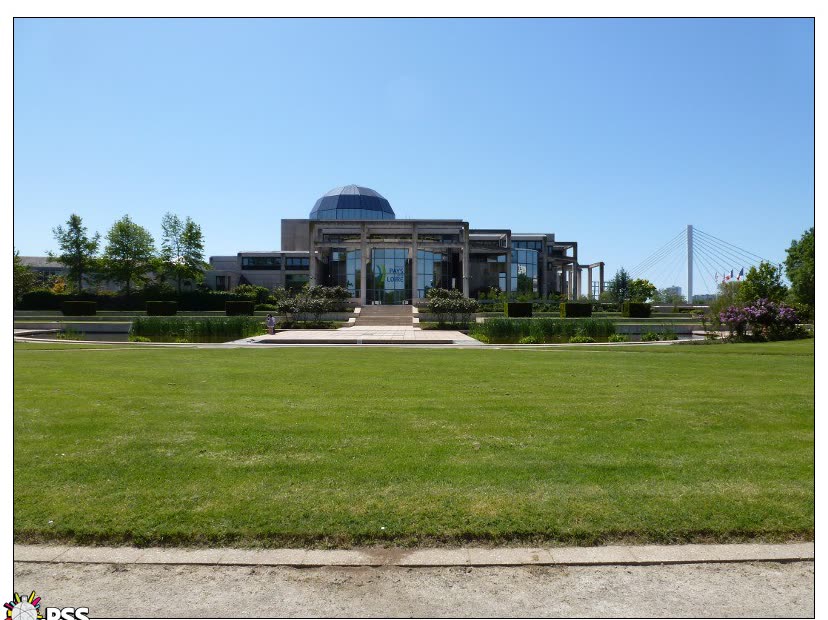
At the eastern end of the Île de Nantes, the former Beaulieu island was one of the Loire islands merged in the 20th century to form today's island. Filled in and raised by about 5 metres after the war, it was built up from the 1960s onwards (in a very concrete-heavy style, with the large housing estates typical of those years!), except for its flood-prone tip. That is where Crapa park (short for "circuit rustique d'activité de plein air", a rustic outdoor fitness trail), now Beaulieu park, was laid out in the early 1980s: a wood where some of the Loire's last wet meadows survive.
Nearby, at 1 rue de la Loire, stands the Hôtel de Région des Pays de la Loire, seat of the regional council since 1987. Designed by Nantes architects Durand, Ménard and Thibault, this postmodern building echoes, on its riverside façade, the quayside buildings that have shaped Nantes since the 18th century, but in an unmistakably 1980s vocabulary.
What I enjoy is the contrast: an institution with solemn lines set on the banks of the Loire, right next to an almost wild patch of nature. The building opens to the public during European Heritage Days, a chance to see it from the inside.
8. The forgotten Heron behind the Nefs, relic of an unfinished dream
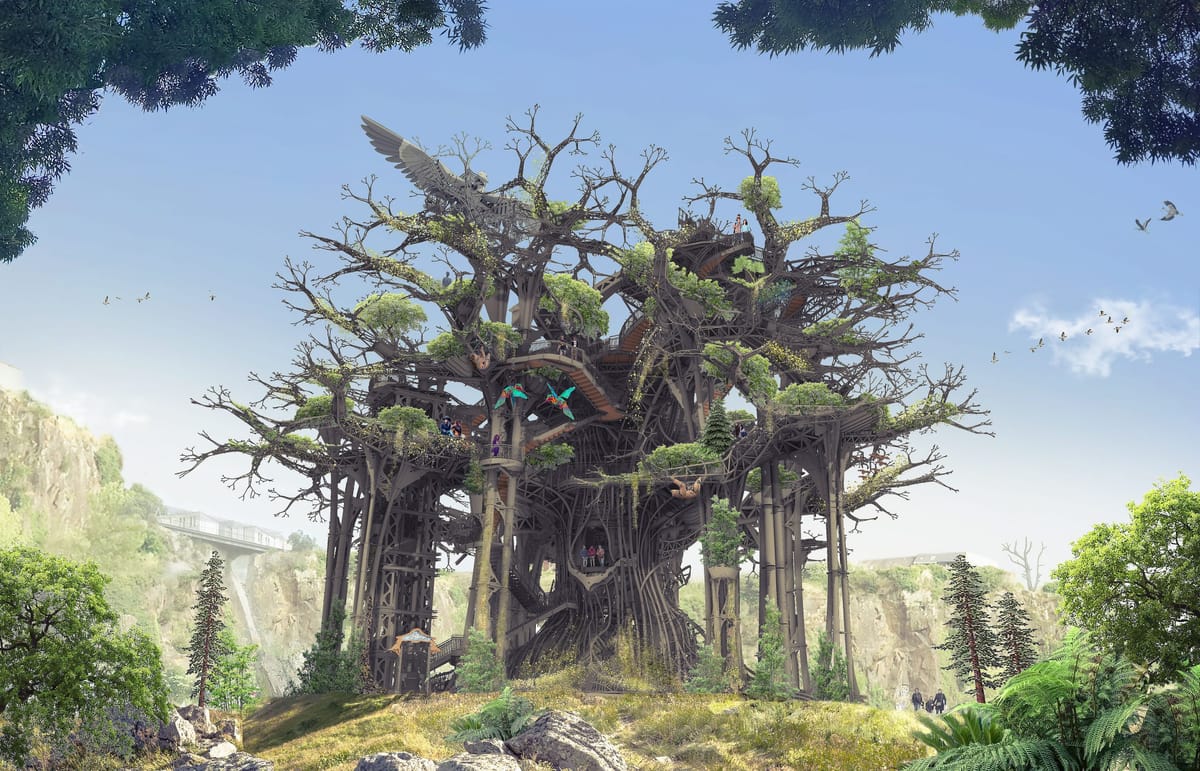
On 1 July 2007, for the opening of Les Machines de l'île, François Delarozière and Pierre Orefice installed a prototype branch near the Nefs of the former shipyards: a first full-size fragment of their wildest project, the Arbre aux Hérons ("Heron Tree"). The complete tree was to be 32 metres high and 50 metres wide, carrying more than a kilometre of hanging gardens and two mechanical herons able to take passengers on a circular flight above the Misery quarry.
The story took another turn: in September 2022, with the budget soaring from about 35 to over 80 million euros, the public project was abandoned. A fully privately funded version has since been studied, but the tree has yet to grow.
That is exactly what makes this heron so moving to me. Weathered by the years, a little away from the crowds around the Elephant, it feels like a promise on hold: the first chapter of a story Nantes has not finished writing.
9. The Chinese Pavilion, a taste of Saigon in Chantenay
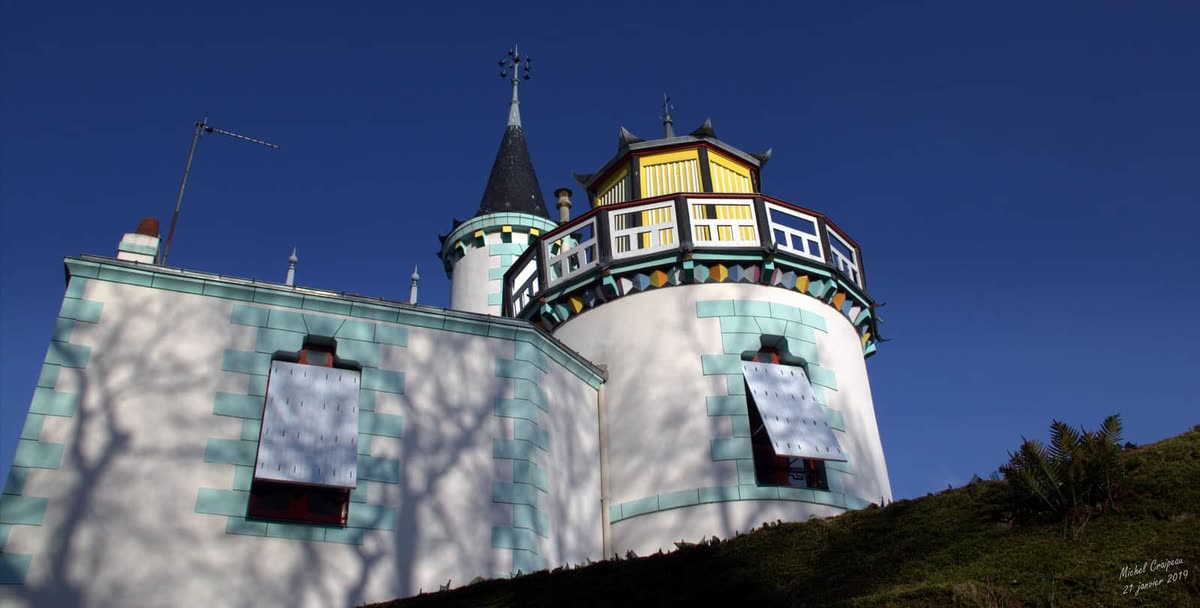
On rue Blanqui, on the heights of Chantenay, a pink and blue silhouette rises above the trees. In the 18th century this was the tower of the last of the three windmills of the Garennes de Pilleux, on land then belonging to the lords of La Musse-Ponthus.
A century later, the tower changed its look. According to local tradition, a Nantes sailor who had spent many years in Asia, notably in Saigon, gave it its pagoda-like appearance to recapture the atmosphere of his travels. Bright colours and an exotic silhouette perched on its old tower: the pavilion looks like nothing else in the city.
It fascinates me because a single building tells two chapters of Chantenay's history: its farming past of windmills and vineyards, then its opening to the world through the port and seafaring. It is private property and cannot be visited, but you get a great view of it from the paths of the neighbouring park.
Bonus: the Serpent d'Océan in Saint-Brevin-les-Pins
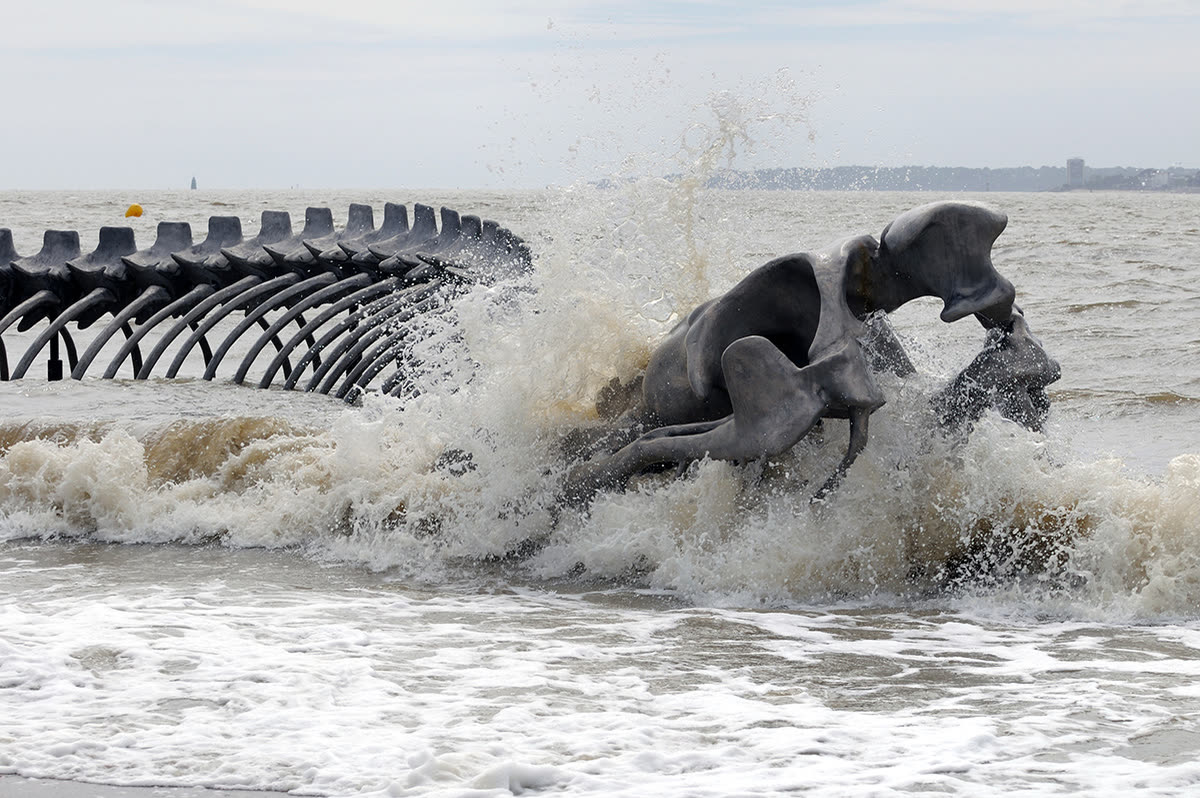
To finish, let's leave Nantes and follow the Loire to the ocean. In Saint-Brevin-les-Pins, on Mindin beach, below the old Nez de Chien fort, the 130-metre skeleton of a sea serpent emerges and disappears with the tides. Installed in 2012 for the last edition of the Estuaire biennial, the work is by Chinese-born artist Huang Yong Ping.
Its spine undulates in echo of the curve of the Saint-Nazaire bridge just opposite, and its position recalls the carrelets, the fishing huts typical of this coast. Over the years the metal has become covered in seaweed and shells: the mythological monster is turning into a reef for marine life.
For me it is the most beautiful ending to the Estuaire trail, where the river meets the sea. Come at low tide to walk around it, then stay to watch the rising tide slowly swallow the serpent. A guaranteed spectacle!
And you, what's your favourite hidden gem?
These places aren't part of my usual tours, but every time they remind me why I love this city so much: Nantes also reveals itself in its margins, its wastelands and its hidden details.
Want to discover the historic heart of the city with the same curious eye? Join one of my guided tours on foot, by bike or by boat, in small groups or privately. And if you know an unusual spot I've missed, drop me a line: it might end up in a future article!